

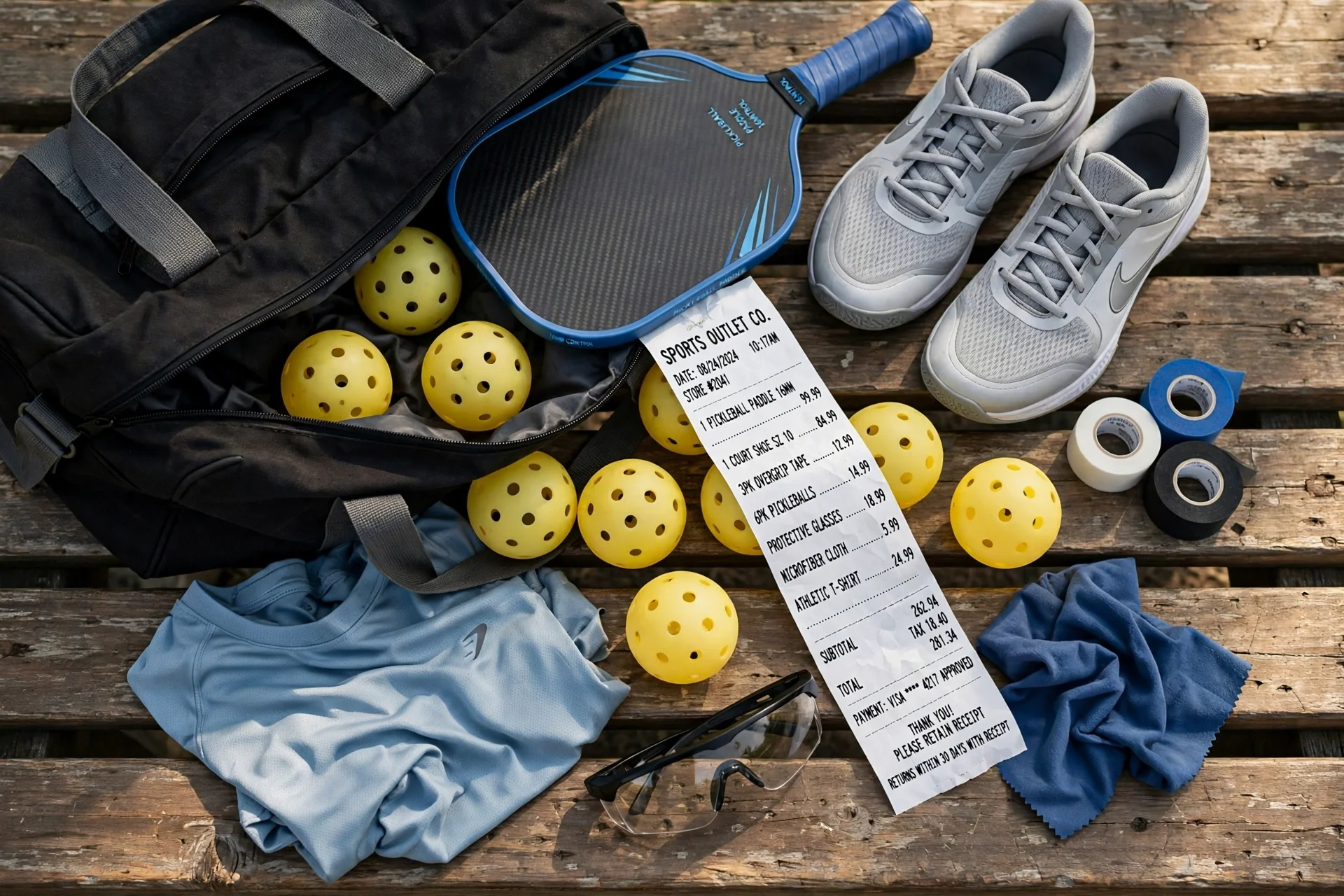
Nobody tells you it's a subscription
I got into pickleball thinking it was a cheap sport. One paddle, a ball, a court that's already there. Compared to golf it basically is.
Then I did the math on a year.
The paddle isn't the expense. The expense is that almost every single thing in your bag is a consumable. It wears out, it stops working, and you replace it — usually sooner than you expected, and usually a few weeks after you stopped noticing it was getting worse. Shoes are the obvious one. But grip tape, balls, edge guard, even the texture on your paddle face all have a shelf life measured in months.
Here's the honest list, what each piece costs right now, and how often you're actually buying it again. I've put the replacement cadence next to every item, because that's the number that matters. A $150 shoe you buy three times a year costs more than a $250 paddle you buy once a year.
The paddle: $100–$300, roughly once a year
This is the purchase everyone agonizes over and it's rarely the one that hurts.
Good paddles land in a wide band. The value benchmark sits near $99 — the Vatic Pro V-SOL Pro is the one that comes up over and over at that price (Pickleheads). Mid-tier lands $150–$200. Flagship thermoformed paddles like the JOOLA Perseus line run $200–$300 (Spinwave Pickleball).
The part people miss: paddles don't last forever. The raw carbon face that generates your spin wears smooth. Most sources put a frequent player's paddle at 6–12 months of good performance, stretching to 18–24 months with careful use (PaddlePal), and one analysis of players hitting three to four times a week puts it at 9–15 months (Pickleball Lookup). You'll know because the ball stops biting on topspin and the sound goes hollow.
Annual cost, 3x/week player: $100–$250
Shoes: $110–$150, two to three times a year
This is the real bill, and it's the one that surprises people.
Court shoes get destroyed by pickleball. The sport is nothing but lateral cuts and hard stops on abrasive surfaces, which is exactly what shoes are worst at surviving. Real-world lifespan runs 2 to 12 months, or roughly 40 to 300 on-court hours depending on volume and surface (Let's Pickleball). Traditional EVA midsole foam loses about 25% of its cushioning after just 30–40 hours of hard play (Let's Pickleball). If you play three or four times a week outdoors, you are replacing shoes two to three times a year. That's not neglect — that's the sport.
Prices: the K-Swiss Hypercourt Express 2 is the most common shoe at outdoor open play, around $100–$130 (My Pickleball Connect). The Hypercourt Supreme 2 is the frequent "best overall" pick at $150 (PaddlersPick). ASICS Gel-Renma lands near $110 and the Skechers Viper Court Pro is the budget-conscious pick (PicklerLab).
Don't ignore the wear signs. Compressed midsole, smooth tread, sole separation, or your foot sliding sideways in the upper all mean the shoe has stopped protecting you (Pickleball.com). Playing on dead shoes is how knees and ankles get hurt.
Annual cost: $220–$450
Balls: $40–$80 a year
Outdoor balls crack. Cold weather makes it worse.
Franklin X-40 three-packs run about $9.97–$11.99 (Walmart Business, Lacrosse Monkey). Selkirk Pro S1 singles sit near $9.99 (Pickleball Central), with 12-packs discounted to around $22 from $29.99 (JustPaddles). Selkirk's own pricing has run about $15 for a 4-pack and $35 for a 12-pack, with a one-year warranty (player price comparison).
If you're the person in the group who brings the balls, budget more.
Annual cost: $40–$80
The small stuff that adds up
These are cheap individually and invisible in aggregate, which is exactly why they escape the budget.
ItemPriceHow oftenOvergrip tape$7–$10 per 3-pack (DICK'S, Eleven Zero)Every few weeks if you sweatEdge guard tape$9.99–$18 (Amazon, Get2Eleven)1–2x a yearPaddle eraser$6.99–$10 (Pickleball Central, Ethos)Lasts a long timeSelkirk lead/tungsten tape~$10 (DICK'S)As you tinker
The paddle eraser is the best value item in the sport. Ten dollars to restore the grit on a $200 paddle face and delay replacing it is a straight win.
Annual cost: $50–$80
Bag: $40–$140, lasts years
Entry backpacks start near $39.99 (Engage Day Backpack), mid-range paddle bags run $89–$110, and the CRBN Pro Team backpack sits at $109.99 with larger duffels above that (Midwest Racquet Sports, Pickleball Nation, Pickleball Clearance).
One of the few genuinely durable purchases here. Buy once, buy well.
Annual cost: $40-$140
Apparel: $150–$300 a year
Performance tees run $18–$41 depending on brand (Babolat, Pickleball Wiki). Shorts land $26–$45 (Selkirk, Kitch). Women's capris and premium pieces reach $79 (Sky Blue Pickleball).
You need enough that you're not doing laundry between sessions. That's the real driver, not the per-item price.
Annual cost: $150–$300
Braces and support: $15–$100 when you need them
Pickleball elbow is real, and so is the knee load from split steps.
Basic compression elbow sleeves start around $9.99–$20 (Amazon). Structured knee supports like the McDavid Level 2 run about $23 (Courtside Culture). Step up to the Zamst ZK-Protect at $90 (Pickleball Central) or DonJoy Performance bracing at $77.99–$219.99 (DonJoy).
Most players spend nothing here until something starts hurting, then spend a lot quickly.
Eyewear: $25–$195, and this is where it gets interesting
Protective eyewear is the only item on this list where the money question is genuinely simple.
Franklin Pickleball Protective Glasses are $29.99 and Onix Owl Eyewear is $34.99 (DICK'S). Tifosi Intense comes in near $25 (FORWRD). Purpose-built pickleball options run higher — CRBN Pivot glasses are $95 and meet ANSI Z87.1 and Z80.3 (CRBN) — and lensless frames from Kitchen Blockers sit at $59–$89.95 (Tenniszon, Pickleball Town). Full category range is roughly $30–$200 (FORWRD).
Buy them once. Wear them every time. A ball to the eye at kitchen range is the injury that ends a season, and the frames cost less than a single pair of shoes.
Here's the part that connects to everything above.
The forgotten line item
Go back through that list and notice the pattern. Shoes: replaced. Paddle: replaced. Grip: replaced. Balls: replaced. Edge guard: replaced. Apparel: replaced.
Everything gets maintained except the eyewear — even though the lens is the part that fails first. The frame outlives everything. The lens gets fogged, smeared, dusted with sunscreen, wiped on a shirt hem until it's hazed with micro-scratches. And then the glasses end up hooked on the fence instead of on your face.
I know, because that's exactly what I did with mine. I spent a whole summer playing through the blur — glasses on but reading every third shot through the fog and smudges.
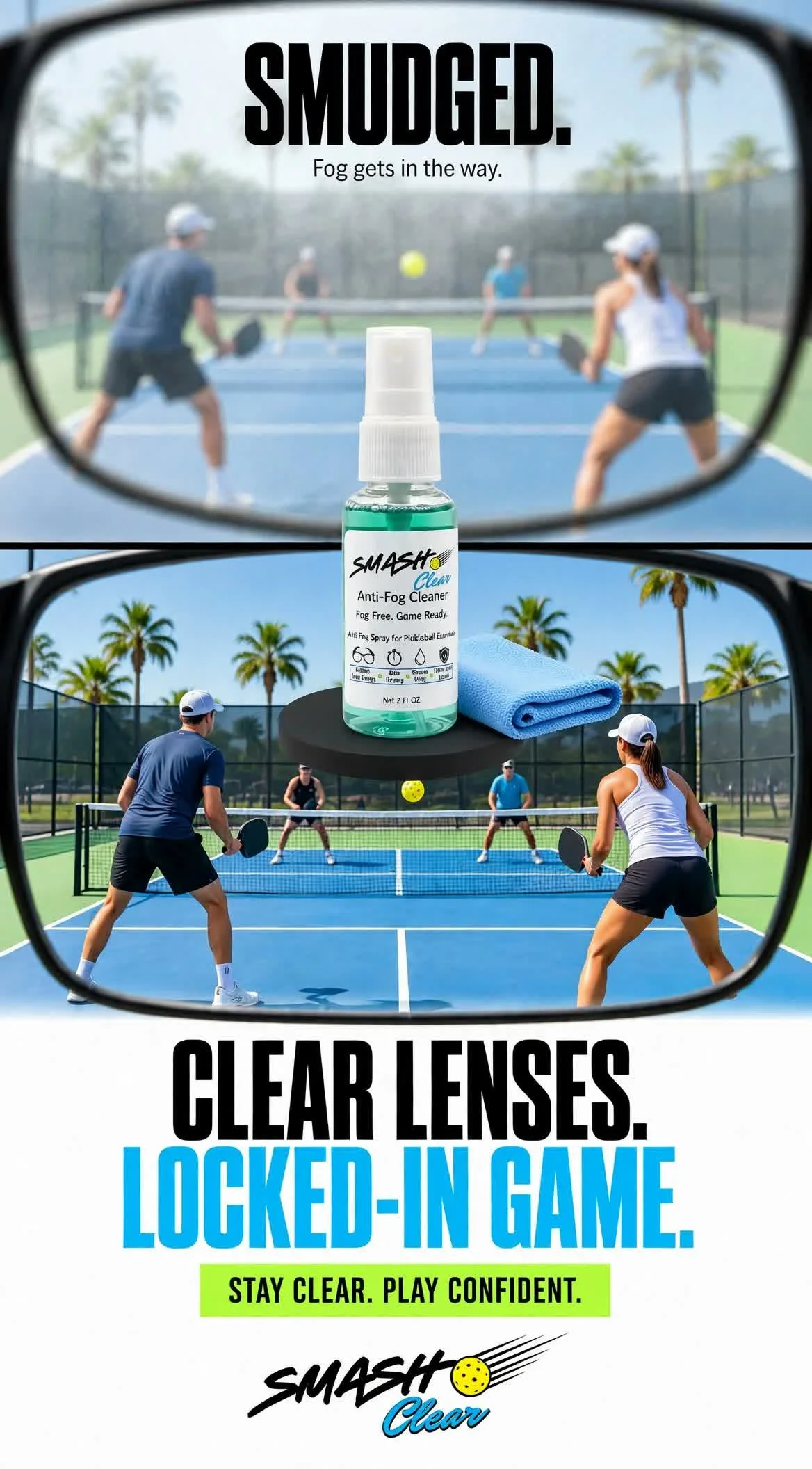
That's the gap SmashClear fills. And it's the cheapest line on the whole sheet.
It's an anti-fog cleaner, not a coating. The formula lowers the surface tension on the lens so condensation spreads into a thin, clear film instead of beading into droplets you can't see through. It won't stop you from sweating, and it isn't permanent — spray it on, buff it off, make it part of your routine.
Thirty bucks. Cheaper than every consumable in your bag — and it's the one protecting the gear that protects your eyes.
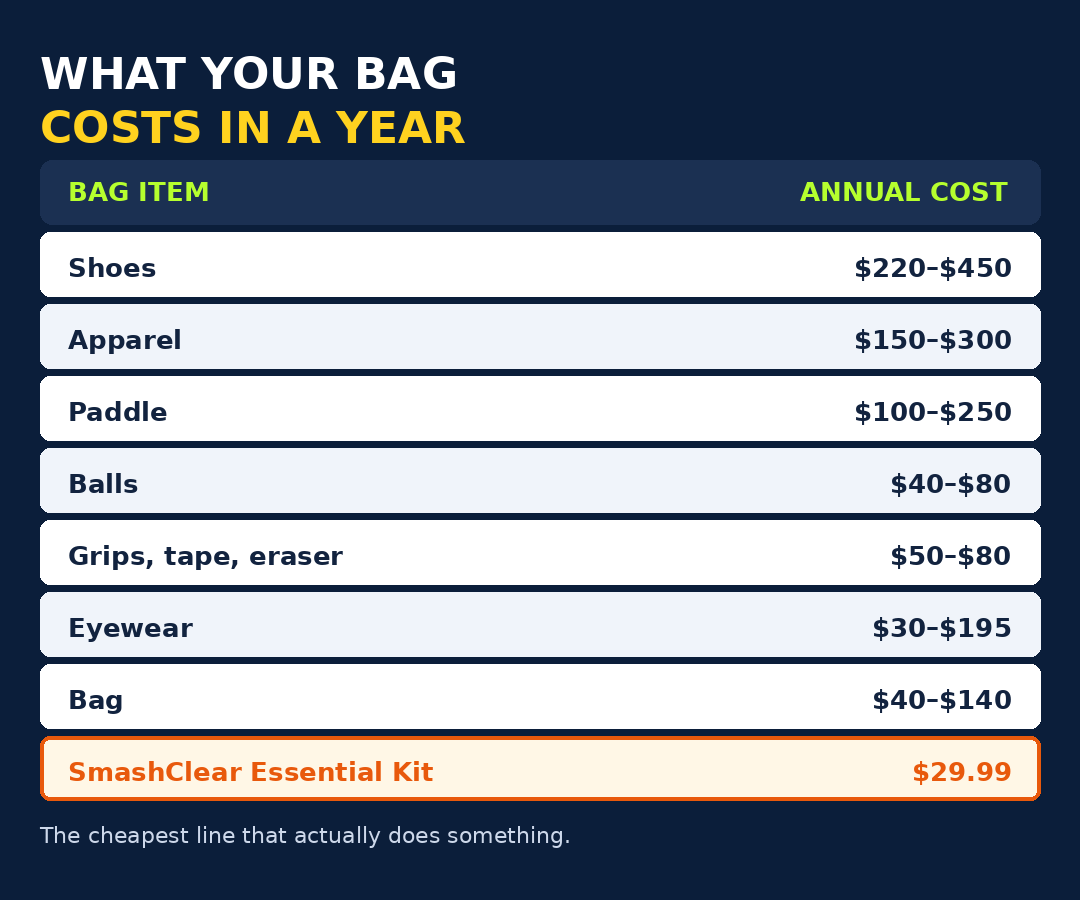
The full year, added up
For someone playing three or four times a week:
Paddle: $100–$250
Shoes: $220–$450
Balls: $40–$80
Grips, tape, eraser: $50–$80
Apparel: $150–$300
Bag: $40–$140
Eyewear: $30–$195 (year one)
Lens care: $29.99
Total: roughly $660 to $1,525 a year, not counting braces or court fees.
Still cheaper than golf. But it's not the $80 sport people think they're signing up for, and the difference is almost entirely consumables.
The move isn't spending less. It's making the expensive things last: erase your paddle face, rotate two pairs of shoes so the foam recovers, re-grip before the tape goes slick, and clean your lenses so you keep wearing the eyewear you already paid for and game ready.
The bag essential isn't the priciest thing you carry. It's the thirty-dollar kit that keeps you seeing the ball.