

Why Pickleball Glasses Fog Up — And What Actually Stops It
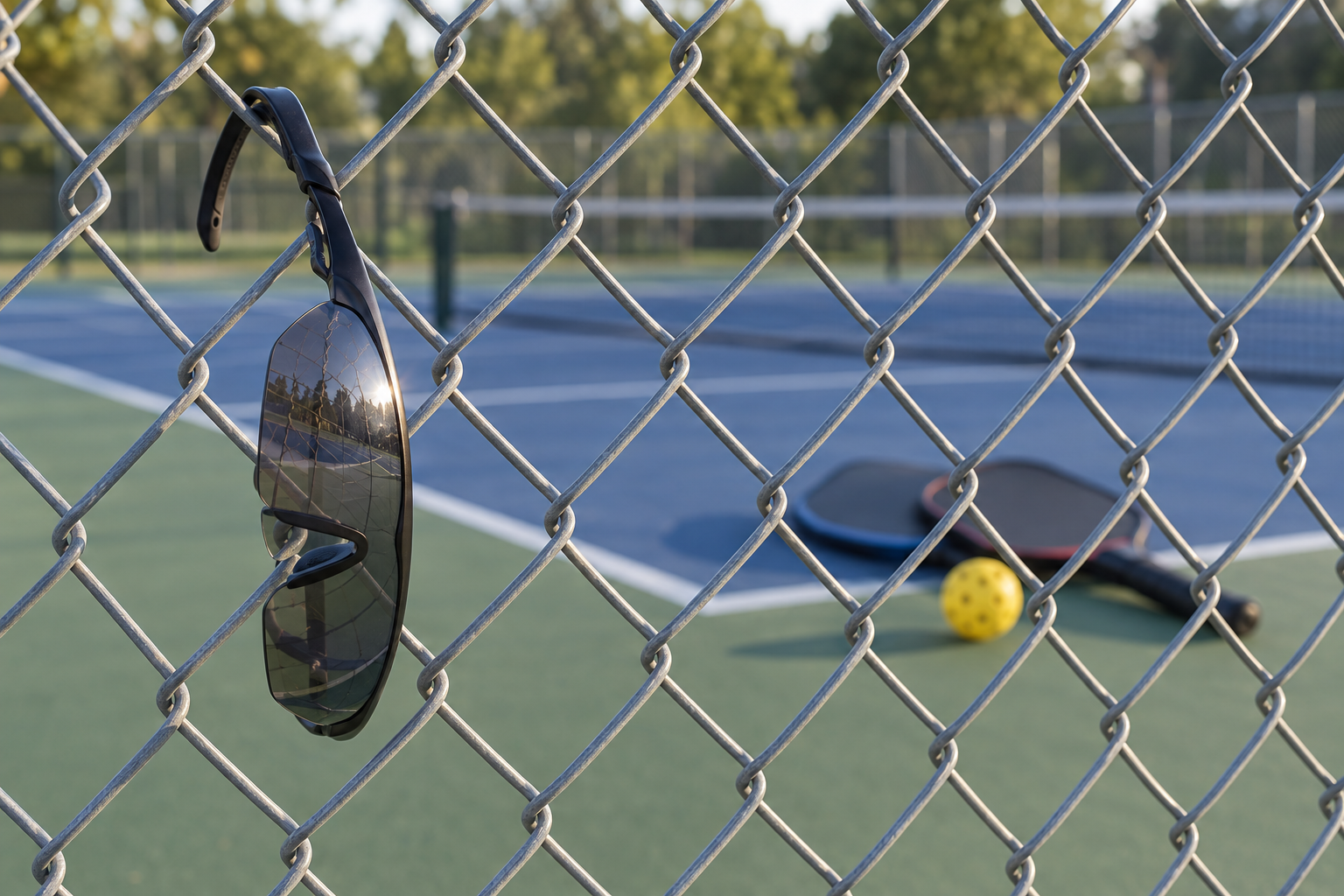
I hung my glasses on the fence in the middle of a match once. Second game, indoor court, and my lenses had gone from slightly hazy to completely useless in about four points. I took them off, hooked them on the chain-link, and played the rest of that game seeing clearly and feeling exposed.
That's the trade this article is about. If you wear eye protection for pickleball, you already know it. Either you can see, or you're protected. Almost nobody talks about how often players quietly choose the first one.
Here's why it happens, why the fixes you've tried didn't hold, and what actually works.
Why it hits pickleball players so hard
Fog is condensation. Warm, humid air coming off your face meets a cooler lens, the air right at the surface drops below its dew point, and water comes out of it as droplets (McGill Office for Science and Society).
Those droplets are the fog. They're small enough to scatter light in every direction, which is why a fogged lens looks milky rather than wet — you're seeing light bouncing off thousands of tiny curved surfaces instead of passing through.
That's true of any sport. What makes pickleball worse is specific:
You're close, and you stop moving. Kitchen exchanges happen inside seven feet with your head still and your face pointed down-court. There's no airflow across your lenses at the exact moment you need to see a ball travelling fast at short range. Then you reset, and the still air behind your lenses heats up again.
The third game is when it gets you. Your core temperature is up, you're sweating steadily, and the air trapped between your face and your lenses is now warmer and wetter than it was in warm-up. Most players I talk to don't fog in game one. They fog in game three.
Indoor courts are the worst environment there is. A gym with no cross-breeze, other people's body heat, and often air conditioning cooling the lens surface while your face warms the air behind it. That temperature gap is the whole mechanism, and indoor pickleball maximises it.
Your forehead drains straight down. Sweat carries oils and, if you play outdoors, sunscreen. Both leave a film on the lens that gives moisture more to cling to. This is why the second half of an outdoor session fogs faster than the first even as the sun warms things up.
Protective eyewear sits close to the face. That's what makes it protective. It also means a small, enclosed pocket of your own warm breath and brow heat, which is precisely the condition condensation needs.
Why wiping makes it worse
Almost every player's first instinct is to pull their shirt up and wipe. It's the single most damaging thing you can do to a lens.
Your shirt is dry cotton carrying court dust, sunscreen, and skin oil. Dry-wiping does three things at once: it smears that oil into a thin film across the whole lens, it drags grit across the surface, and it strips whatever anti-fog treatment is still on there.
The grit is the part players underestimate. Fine dust on a polycarbonate lens under finger pressure is an abrasive. Every dry wipe puts microscopic scratches into the surface, and a scratched lens fogs faster than a smooth one because there's more surface texture for moisture to catch on.
So the wipe clears your vision for one point and makes the next fifty worse. If you have to clear a lens mid-game, wet it first.
New glasses that stopped working aren't defective
Most protective eyewear ships with a factory anti-fog treatment. It's thin, and it's consumable. Sweat, sunscreen, oils, and repeated cleaning break it down over weeks of regular play.
Two signs it's gone rather than just having a bad day:
· Fog forms within a few minutes and stays for a whole game
· Conditions that never used to fog you now fog you every time
A short fog at the very start of a session is different — that's just the air behind your lenses reaching equilibrium with the room, and it clears on its own.
The one thing that actually matters: droplets versus film
Here's the part most advice gets wrong, and it's the difference between a fix that works and one that makes things worse.
You cannot stop moisture landing on your lens. Your face is warm and wet and the lens is cooler. That's physics.
What you can change is what the moisture does when it lands. Water beads up because water molecules are more attracted to each other than to the lens surface. Lower that surface tension — get something in between the molecules so they stop clinging to each other — and the water stops beading. Instead it spreads out into a film thin and flat enough that light passes straight through it (McGill Office for Science and Society).
That's the whole trick. Not a dry lens. A lens where the water is invisible because it's flat.
This is called a hydrophilic — water-loving — film, and it's how proper anti-fog treatment works. Hydrophilic coatings absorb moisture and spread it into an even surface (peer-reviewed research on anti-fogging films).
Why water-repellent products don't fix interior fog
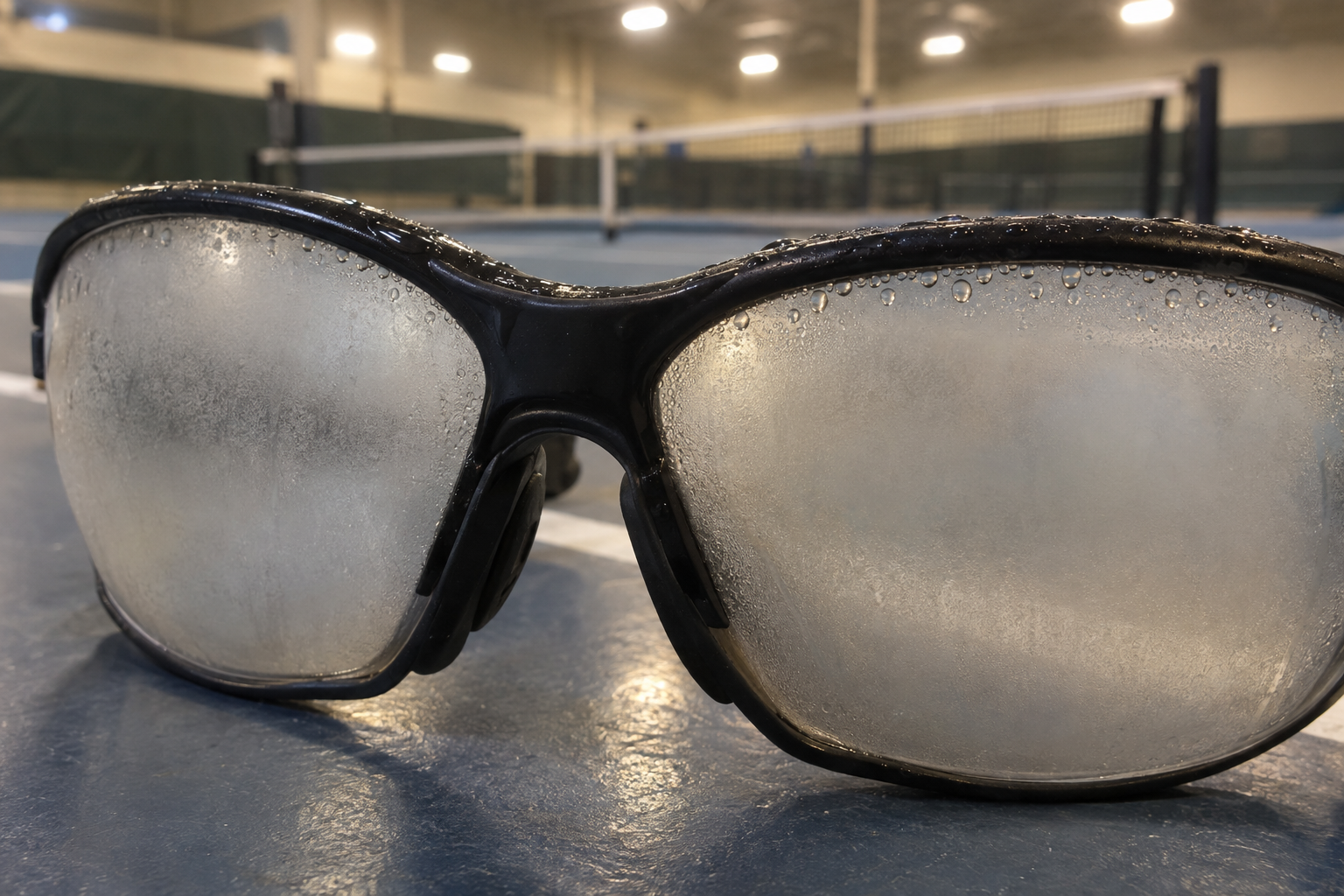
Fogged pickleball lenses
This is worth understanding because plenty of products sold as anti-fog are actually hydrophobic — water-repellent — and it's the wrong tool for the inside of a lens.
Hydrophobic coatings work by making water bead tightly and roll off. On a windshield or the outside of a ski goggle, gravity and airflow carry those beads away and it works well.
On the inside of your pickleball glasses there's no wind and no useful gravity. The beads just sit there. And the research is blunt about it: hydrophobic coatings only produce an anti-fogging effect once droplets grow large enough to detach from the surface or when an external force moves them, and they suffer from low durability and short lifespan, needing frequent reapplication (PMC).
Which means a repellent coating on an interior lens surface is doing the one thing you don't want: turning humidity into beads. Beads are fog.
If a product's pitch is that it repels moisture, it's built for the outside of a lens.
What players actually try, and how long each lasts
Spit. It works, and I'd rather tell you that than pretend otherwise. Saliva contains mild surfactants that lower surface tension on the same principle as a purpose-built treatment, which is why divers have used it for decades (Scuba.com) and swim coaches still recommend it (Swim School Austin). The problem is duration — it rinses away and breaks down as you sweat, generally inside a game, and it leaves residue that attracts grit onto your coating.
Baby shampoo, heavily diluted. Same mechanism, slightly longer, and popular with swimmers. Inconsistent on court, leaves residue if you get the dilution wrong, and it's one more bottle in a bag that's already full.
Dish soap. Skip it. Detergents strip lens coatings, and the fog comes back worse once the factory treatment is gone.
Household glass cleaner. Actively damaging. Ammonia-based cleaners are harder on lens coatings than fogging ever was.
Breathing on the lens then wiping. This is a cleaning step, not an anti-fog step, and if you finish it with a dry shirt-wipe you've just done the damaging thing.
Ventilated or double-pane eyewear. Genuinely helps, and worth considering at your next purchase. It reduces how fast the pocket behind the lens heats up. It doesn't eliminate fog in an indoor gym in July.
A headband or visor. Also genuinely helps — it intercepts brow sweat before it reaches the lens. Pair it with a treatment rather than instead of one.
A purpose-built anti-fog spray. A properly formulated hydrophilic treatment does what spit does, holds for games rather than a few points, and doesn't leave a residue that collects grit. This is what SmashClear is.
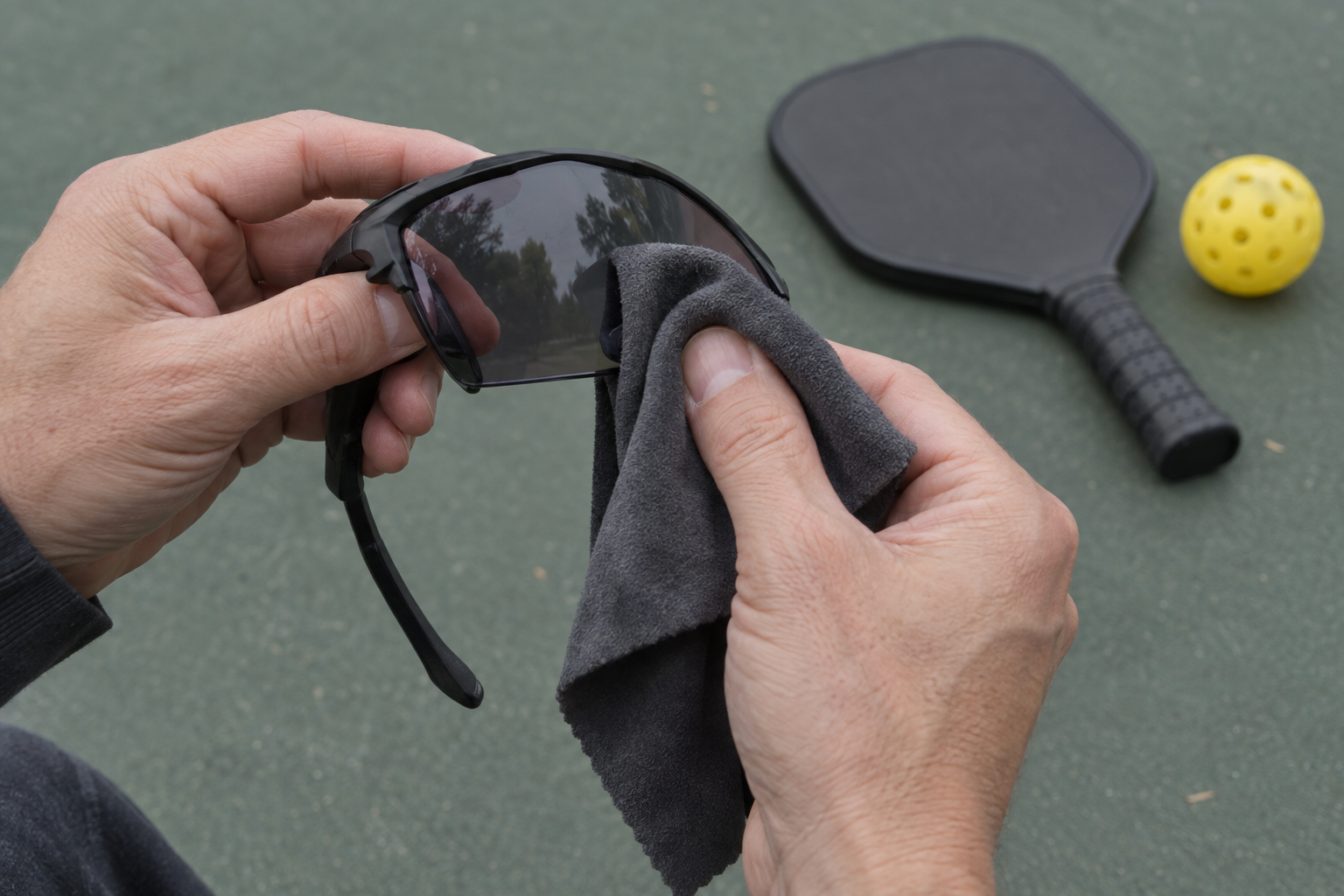
Buffing lenses
How to apply it so it actually works
Most complaints about anti-fog sprays come down to application. The film needs a clean, dry surface to form on.
1. Clean the lens first with a lens-safe cleaner. Oils and sunscreen block the film from bonding evenly.
2. Dry it completely with a clean microfiber cloth.
3. Two sprays per lens, on the inside surface. More isn't better — it just takes longer to buff out.
4. Buff with a clean microfiber cloth until the haze is gone.
5. Give it a minute to set before you put them on.
Do this at home before you leave, not courtside between games with sweat and dust already on the lens. Rushed application on a dirty lens is why people conclude the product doesn't work.
How often to reapply
Most players get several games from one application. Humid days, indoor courts, and heavy sweating shorten that, and some players reapply between games in those conditions.
Two things to know:
Aggressive wiping removes the film. Any time you scrub a lens hard, you've taken some of the treatment off. Reapply after a real cleaning.
With a hydrophilic treatment, repeated use compounds. The film builds up over successive applications, so lenses resist fog longer the more consistently you use it. The bottle you're halfway through is working better than it did new — which is not something most things you buy can claim.
Keeping it working longer
· Store them in a ventilated case or pouch, not on a hot dashboard.
· Never dry-wipe. If there's grit, rinse with clean water first.
· Rinse after dusty outdoor sessions so the grit isn't waiting for your next wipe.
· Treat brand-new lenses right away, even with the factory coating intact.
· Build it into your routine — before league night, before a tournament morning — rather than reacting once you're already fogged.
The actual point
Protective eyewear only works if you can see through it. Fog is the number one reason players stop wearing eye protection, and every player who takes their glasses off at the kitchen is making the same trade I made on that fence.
You shouldn't have to. That's the entire reason SmashClear exists.